
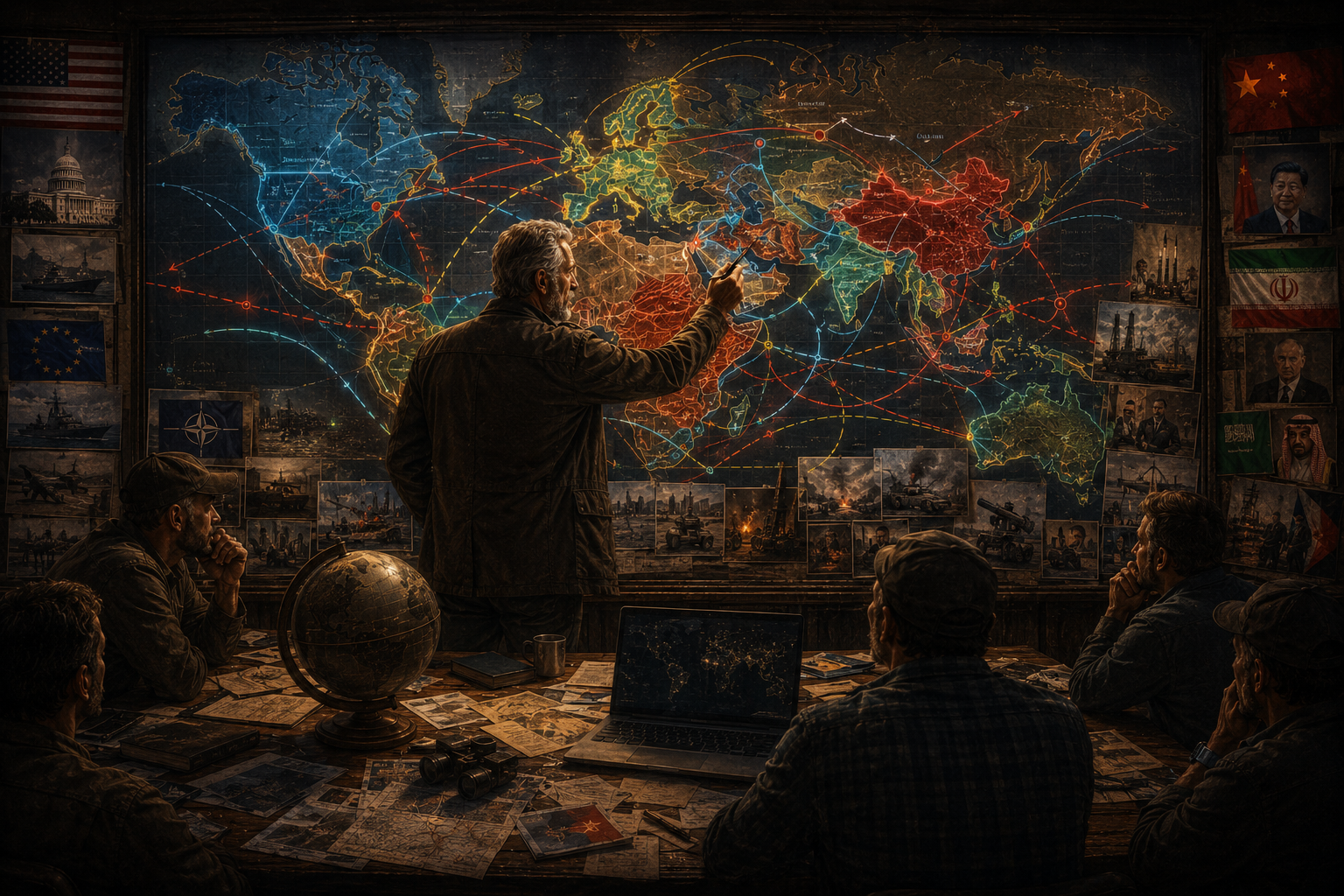
Ideology
Political Ideology
Radical Ideology
The man they drove out to see keeps forty banker's boxes in a rented storage unit off the state highway, and there is nothing in any of them but primary documents.
Party platforms. Founding charters. Manifestos in the original printing where he could get one and a clean photocopy where he could not. Program statements. Congress minutes. The speech as delivered rather than the speech as reported. He is somewhere in his eighties, he does the whole thing on a fixed income, and he will not keep a single volume of commentary in the unit. He told them why in the first ten minutes, standing in the doorway with the roll-up door still rattling on its track.
"Commentary's free. Anybody will hand you commentary. Try getting a man to hand you the thing itself."
The Brain had brought the list — the one column, the hundred and forty names, where each of them worked before and where each of them went after — and he laid it out flat on a folding table under a shop light, the way he had laid it out on a kitchen table before, and waited.
The old man glanced at it for maybe four seconds. Then he pushed it a few inches to the side, the way you move a plate you are done with.
"That's a manifest," he said. "You came out here because you want the crate."
He went down the row, put his hand on a box without looking at the label, and came back with a thin book. Forty-odd pages. Cheap paper, soft corners. He held it out to the Skeptic, who took it the way you take something you have decided in advance not to be impressed by.
"That has been in print continuously since 1848," the old man said. "No foundation had to fund it. No agency had to place it. Nobody in the history of the world was ever paid to read it. It got picked up, and passed hand to hand, and copied out longhand in countries where owning it would get you shot, because it told a man something he wanted to hear badly enough to risk that. Your list explains the trucks. It does not explain one single person who ever wanted the freight."
Then he pulled a legal pad off the table and set it in front of them, and he said the thing they drove home in silence about.
"Before you read it — any of you — I want a page. Three lines. What is wrong with the world. Whose fault it is. What would fix it. Write what you actually believe, not what you'd say in front of people."
The Brain had his three lines down in under a minute. The Believer wrote slowly and crossed one out twice. The Scribe wrote hers and then sat looking at it with an expression none of them could read.
"Now the second column," the old man said. "Beside each line, write where you got it."
That is where the room went quiet.
The Captain is the one who steers. He decides where they go, he has decided where they go for thirty years, and he is not a man who is slow with a pen. He got his three lines down as fast as the Brain did. Then he moved the pen to the second column and sat there with it, and the shop light buzzed, and he did not write anything at all.
"I don't know where I got any of it," he said finally. "I've been steering by this my whole life."
He looked up.
"How do you tell the difference between a thing you worked out and a thing you were handed?"
Nobody in that unit had an answer for him. That is the night this transmission starts.
Ideology
"Such a person feeds on ashes; a deluded heart misleads him; he cannot save himself, or say, 'Is not this thing in my right hand a lie?'" — Isaiah 44:20
Read what that verse actually accuses him of, because it is not the thing you expect.
It does not say he was lied to. It does not say somebody deceived him, sold him something, ran an operation on him. The chapter around it has him doing the whole job himself — he picks the tree, he seasons the wood, he burns half of it to cook his dinner and warms his hands at the fire, and out of the leftover half he makes the thing he then asks to save him.
And the charge at the end of it is not that he answers the question wrong. It is that he cannot ask it. The words are not available to him. The thing is in his own right hand, he can feel the weight of it, and the sentence is this a lie will not form.
That is the condition this file is about, and every man reading it is in some measure inside it right now. Not because he is stupid. Because a frame you are looking through is the one thing in the room you cannot look at.
The previous transmission tracked the trucks. This one is the freight.
Five Answers, Welded Into One Piece
A political opinion is a thing you hold. A creed is a thing you hold everything else with.
The difference is not intensity and it is not extremism. It is structure. A full framework answers five questions, and the answers come welded together rather than loose.
What is real. Matter and nothing else, or spirit and matter, or history moving under its own law, or nothing at all outside the language people use about it.
What is good. Liberty, equality, order, purity, the nation, the class, the self, the planet, the will.
What man is. Blank paper. Born good and bent by his conditions. Born bent and restrained by his conditions. Infinitely reworkable. Fixed by his class, his race, his sex, or by nothing whatsoever.
Where this is all going. Forward and upward by default, in circles, downhill, toward a crisis that settles it, toward nothing.
What you should do about it Tuesday morning. Which is the only one that ever gets argued out loud.
Five answers, one piece. That is the whole engine. The man carrying it does not consult it — he sees through it. A news story, a neighbor, a law, a war, a Scripture, his own son: each one arrives already sorted, already meaning something, before he has had a conscious thought about it.
And it is efficient. That is the part the file has to be honest about. A man with a complete frame can process the world at a speed a man without one cannot match, and he will win most arguments against him, and he will sleep better. The cost is not paid in confusion. It is paid in the one thing he can no longer do, which is notice evidence that does not fit.
Why Anyone Wants One
Nobody adopts a framework because it is true. They adopt it because it arrives as relief.
Understand the position of the man it lands on. Something in his life has gone wrong that he did not cause and cannot explain — the plant closed, the marriage failed, the neighborhood turned, the promotion went sideways, the country he grew up in stopped being recognizable. He is carrying a weight with no name on it. Pain without a story attached is nearly unbearable, and he has been carrying that particular kind for years.
Then something hands him four things at once.
A beginning — here is how the trouble started, and it started before you were born, so it is not your failure. An enemy — here is who did it, and here is why you were right to feel what you have been feeling. A duty — here is what you personally can do, starting today, and it matters. An ending — here is what the world looks like when this is finally set right, and you will have helped.
Beginning, enemy, duty, ending. Every framework that has ever spread at scale delivers all four in the first hour. Every framework that has failed to spread was missing one of them, usually the third.
That is not brainwashing. Nobody had to be paid. It is a hungry man being handed a plate, and the honest reader will admit that he has taken the plate himself at least once, and that it tasted like clarity.
The Shape Underneath
Line those four up against the shape of a religion and there is no daylight between them.
A beginning is a doctrine of the fall. An enemy is a doctrine of sin, with an address. A duty is a doctrine of salvation and the works that go with it. An ending is a doctrine of last things. Add the saints, the heretics, the excommunications, the sacred texts, the reverence for founders, the conversion testimonies, the horror at the unclean — and what a man is holding is not a policy preference. He has built a church and hung a political sign on the door.
"My people have committed two sins: They have forsaken me, the spring of living water, and have dug their own cisterns, broken cisterns that cannot hold water" (Jeremiah 2:13).
Two sins, not one. That is the part that gets skipped. Leaving the spring is the first. Digging is the second — and digging is work. Nobody digs a cistern out of laziness. A man digs because he has to have water, because water is not optional, because the need is real and the need does not go away just because he has walked away from the source. The condemnation in that verse is not aimed at a man who wants water. It is aimed at what he settled for and how hard he worked to keep it.
Which explains the single strangest thing about modern political life, the thing everybody notices and nobody accounts for: disagreement is no longer treated as error. It is treated as blasphemy.
If your position is a policy, a man who disagrees with you is mistaken and you can eat dinner with him. If your position is your cistern — your account of the fall, your enemy, your duty, your hope — then a man who disagrees is not mistaken. He is defiling. He has to be driven out of the room, out of the job, out of the family, because his presence is a threat to the only water you have.
Watch for the giveaway. It is not anger, and it is not certainty. It is the moment a man becomes unable to describe the other side's position in a way that side would recognize. He is not permitted to. Understanding it would require standing outside his own frame for the length of a sentence, and the frame does not allow that. He does not know it. He genuinely believes he is describing them.
"They worship me in vain; their teachings are merely human rules" (Matthew 15:9).
And note where Christ says it. He is not addressing pagans or a foreign empire. He is addressing the most doctrinally serious men of his generation, inside the true religion, with the correct book open in front of them. The substitution is not an outsider's problem. It runs cleanest in men who are already devout, which is why the church has never once been immune to it, and is not immune to it now.
Six Questions That Will Take Any of Them Apart
The old man's exercise cannot be run on yourself from the inside. Isaiah already said why. It can only be run from the outside, on a named system, with the founding text open — and the practice of doing it to them is what eventually gives a man the words to do it to himself.
Six questions. An evening apiece.
What does it say is real? Every framework smuggles in a metaphysics, and almost none of them announce it. Find it and the rest of the machine becomes legible in about ten minutes.
What does it say a man is? Tell me what a system believes about human nature and I will tell you what it will do to human beings once it has the power to do anything. There are no exceptions to that rule. A system that thinks man is infinitely reworkable will eventually rework him, and the reworking will be done to somebody who did not volunteer.
Where does it put the evil, and what does it prescribe? Every one of them has a diagnosis and a cure hiding under the vocabulary. Property and revolution. Blood and purge. Oppression and awakening. Ignorance and education. Repression and release. Find the pair and the religious shape is standing in front of you.
What happened when it ran? Not under ideal conditions. Not in the version its defenders describe. What has it actually done to the populations that have lived under it, counted in bodies, prisons, famines, and children who did not get born. The record on the twentieth century's two great secular frameworks is not in dispute and is not small.
Where does it agree with Scripture, and where exactly does it stop? Almost every one of them is running on a stolen truth — that the poor matter, that the powerful lie, that the nation is worth loving, that a man should be free. That is precisely why they work. Naming the point where the borrowed truth ends and the substitution begins is the entire skill, and it takes more honesty than either denunciation or endorsement.
What is it doing inside the man who holds it? Is it giving him his identity? His friends? His sense of being on the right side? His hope? If the answer to three of those is yes, he is not going to be argued out of it by facts, and neither are you.
Where the Present Ones Came From
None of this is airborne. All of it has parentage, and the parentage is a matter of public record.
The tradition of natural rights, limited government, free exchange and the rule of law runs out of Locke and Smith and the wider Enlightenment argument, and it is the water the American founding documents were written in. The conservative answer to it was set down by Burke against the French Revolution: prudence over abstraction, inherited institutions carrying wisdom nobody alive can fully articulate, and a hard warning about what happens to a society that decides to start over from a blank page.
Marx and Engels published in 1848 — that thin book in the storage unit — and the twentieth century ran the experiment at population scale in Russia, China, Eastern Europe, Cambodia, North Korea and Cuba. The death toll is documented and is worked at close range in Class Warfare.
Fascism and National Socialism came out of the wreckage between the wars and produced the camps. The same hundred years that delivered one body count delivered the other. Any man who has an explanation for one of them that cannot account for the other is holding a frame rather than a history.
The Frankfurt School emigrated, took root in the universities, and its descendants now operate under a family of newer names, popularized down into a vocabulary a teenager can use without ever having read a page of the source. The cultural weather a man walks through daily is downstream of that stream.
And then the recombinations — the progressive, the libertarian, the traditionalist, the populist of the left and the populist of the right, the nationalisms, the identity movements, the various post-liberal projects. Most of them are recombinations rather than inventions, and their parts are traceable.
"Then they sweep past like the wind and go on — guilty people, whose own strength is their god" — Habakkuk 1:11
That is the terminal condition of every framework that gets all the way to power, and it is stated in seven words. Not a stated atheism. Something quieter and much later in the process: the moment the movement's own strength becomes the thing it actually trusts, whatever it still says on Sunday. Habakkuk was watching an empire he hated being used to discipline a nation he loved, and God's answer to him was not a slogan. It was a very long look at what that empire's own confidence was going to cost it.
A framework you cannot trace is a framework you cannot weigh. That is the whole reason the boxes are in the unit.
The Stack
Here is what the second column actually exposes, and why the Captain could not write in it.
Most men are not carrying one framework. They are carrying three or four, stacked, absorbed from different places at different ages, contradicting each other at the seams — and they call the stack their personal beliefs.
There is usually a moral frame absorbed young, from a church or a grandmother or a coach, still running. There is a frame absorbed through school and entertainment, which taught him what a good person sounds like, what a villain looks like and which questions are embarrassing to ask out loud. There is a buying frame, absorbed from thirty years of advertising, which taught him that a dissatisfaction is a thing you resolve by acquiring something. And there is the political jersey he actually wears, which is often the thinnest layer of the four and the only one he thinks of as a belief at all.
He never chose any of them. He accumulated them, the way a man accumulates an accent.
And the reason it stays invisible is that a framework almost never arrives labeled. It arrives as common sense. As what decent people think. As the obvious. As not-really-a-position-at-all — which is the strongest possible position, because it never has to be defended, only assumed. The label is the last thing you get, and usually somebody hostile gives it to you.
So the second column is not a trap and it is not an accusation. It is a genuinely hard piece of work that most men have never attempted once in their lives, and the honest first answer to nearly every line of it is I don't know.
That answer is not a failure. It is the first true sentence in the exercise.
Two Ways to Wreck This
The first is the man who learns the word and starts swinging it. Everything is an ideology now. His brother-in-law is not wrong about the school board, he is captured. His pastor is not cautious, he is compromised. His wife does not disagree with him, she has been programmed. Within about a year he has a complete explanation for every person who has ever disagreed with him, which means he has stopped being able to be corrected by any of them, which means the tool built to get him out of a frame has become the frame. He is now doing the exact thing the file warned him about, in the file's own vocabulary, and he cannot tell.
The second is the man who says it is just politics. He is tired, he is busy, he has a family, and he has decided that all of this is theater and none of it touches him. So he does not read anything, does not trace anything, cannot name a single thing he believes or where it came from — and he is the single easiest man in the country to move, because you cannot refuse an offer you never noticed was made. He does not hold a frame. A frame holds him, and it will steer his children through him without either of them ever seeing it.
The first man cannot be corrected. The second cannot be reached. Both of them got there by refusing to hold the thing at arm's length and look at it.
Why This Sits in a File About the Soul
Because the ground a man measures from cannot be a thing he assembled.
That is the failure mode under all of it. Every framework in the storage unit was built by men, out of the material available to them, in a particular century, in answer to a particular grievance, and every one of them will eventually be handed the same test: what does it do when it gets what it wants? The record on that test is public, and it is grim across the board, and it is grim for the ones flying a Christian flag too.
"This is what the LORD says: 'Cursed is the one who trusts in man, who draws strength from mere flesh and whose heart turns away from the LORD'"
— Jeremiah 17:5
Read the middle clause slowly, because it is the diagnostic one. Not obeys man. Not votes with man. Draws strength from. Where a man goes to get his nerve back on a bad afternoon is where his heart actually lives, whatever he would say about it under questioning — and a framework that supplies a beginning, an enemy, a duty and an ending is in the business of supplying exactly that. The verse does not end with a punishment. It ends with a description: a bush in a wasteland, standing in a dry place, unable to see it when relief finally comes. That is what it looks like from outside, and it is never what it feels like from inside.
So the Christian position here is not that Christianity is the best of the frameworks. It is not in the catalog at all. It is the standard the catalog gets weighed against, and a man who has quietly reversed that — whose faith has become the religious wing of a political program, whose Scripture reading now confirms his voting pattern with a consistency that should frighten him — has already been captured. He has not noticed, because captured men do not notice. That is the whole finding of Isaiah 44.
And there is a second thing in it, harder than the first.
Every framework in those boxes tells the man holding it that he is on the correct side of the line. That is a service it provides, and it is a large part of why he keeps it. The book the old man would not stock in his unit does the opposite thing first. It puts him on the wrong side of the line before it says anything else to him, and it does not offer him an enemy to blame it on.
No creed will do that voluntarily. It is a strange feature of a document that claims to be good news, and this file is not the room where it gets explained.
Where the File Goes Deeper
Political Ideology — the catalog that admits it is a catalog. The recognized systems, each read in its founding language and then against its record: Capitalism, Socialism, Communism, Fascism, Liberalism, Conservatism, Libertarianism, Progressivism, Nationalism, Republicanism, Monarchism, Anarchism, Theocracy.
Radical Ideology — the movements that were never going to be satisfied with winning an election, because the thing they want changed sits underneath elections: Marxism in its revolutionary form, Feminism and the Gloria Steinem file, the Hippie Movement, and White Supremacy with the counterfeit theology that has attached itself to it.
Read the founding text before the commentary in every case. The unit has no commentary in it for a reason.
Closing the Transmission
Go back to the second column, because the Captain's question has an answer and it is not the one he wanted.
You cannot tell from the inside. Isaiah settled that at the top of the file — the thing is in your own right hand and the question will not form. There is no amount of sincerity, intelligence or introspection that gets a man around it. Every one of the boxes in that unit was filled by men who were sincere.
What you can do is the only thing that has ever worked. Get the frame out where you can see it. Read what it says when it is talking to its own people rather than to you. Find out what it did the last time it got everything it asked for. And weigh it against a standard you did not write, cannot edit, and do not control — because a ruler you made yourself measures nothing.
But there is a limit on this room, and the crew hit it on the drive home.
Nothing in those boxes has ever knocked on a door under its own name. Not once in two centuries. No framework has ever walked into a man's life and introduced itself as a framework.
It arrives as an opinion about one specific thing. A vote. A law. A flag on a house. A word somebody used at work that used to mean something else. A thirty-second clip. And it is almost never in the hands of a stranger. It is in the mouth of a nephew across a holiday table, a daughter three months into her first semester, a brother who has started sending links at one in the morning, a wife who has gone quiet on a subject the two of you used to agree about.
And every tool in this transmission is useless right there. You cannot ask a nephew for his founding text. You cannot hand your daughter a track record. The six questions take a system apart beautifully and do absolutely nothing for a man sitting across from somebody he loves, who has just said the thing out loud, while the food gets cold and everyone else at the table waits to see what he is going to do. That is not this room. This room only got you as far as knowing what is in the crate. The next room is the table.