
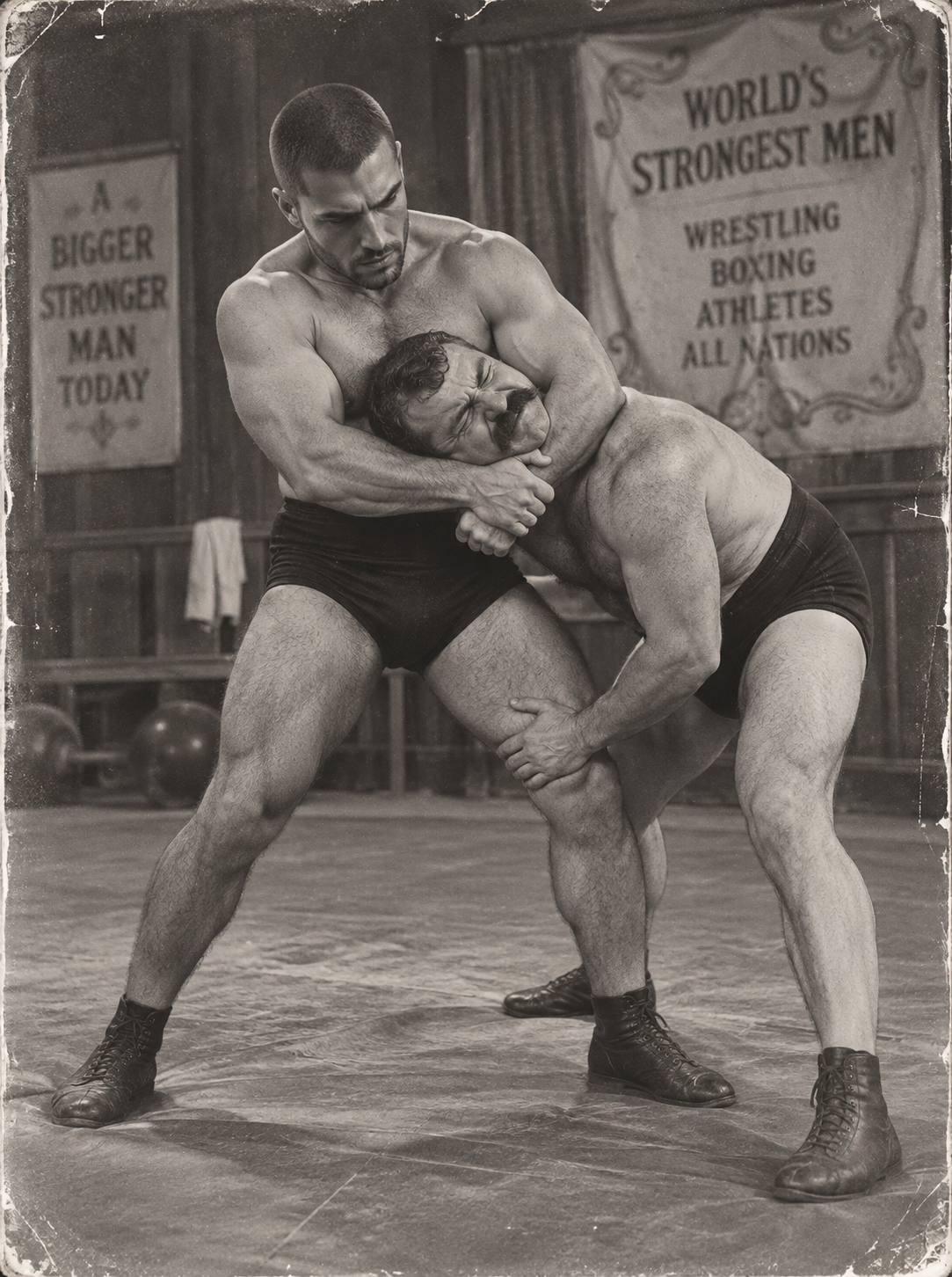
Catch Wrestling
"Conditioning is your best hold." — Karl Gotch
The Carnival Tent
The Warrior does not take you to a gym for this one. He takes you to a county fair.
Not a real one. He describes it, standing on the mat behind the barn, and he describes it so well you can smell the sawdust. A canvas tent at the edge of the midway, a hundred and twenty years ago, with a barker out front and a sign that says the man inside will pay any local who can last fifteen minutes with him. The local is a farmhand, a blacksmith, the strongest boy in three counties, and his friends have put up the dollar and are yelling. Inside the tent is a man half a head shorter than him with ears like cauliflower and forearms like fence posts who has done this in forty towns already this summer. The farmhand rushes him. Ninety seconds later the farmhand is face down with his own toe bent toward his spine, tapping the canvas and howling, and the man on top of him has not broken a sweat and never will.
"They called him a hooker," the Warrior says. "Not because he had a hook. Because he had a hundred of them. Anything that made a man quit was a hook. That's the whole art. No jacket, no belts, no points, no positions to hold for time. You caught what you could catch, and you made him say uncle." He shrugs. "Everything you just walked on this floor that doesn't wear a jacket came out of this tent. The Brazilians built their poor man's art from it. The Japanese built a ring around it and put the honesty back. And a Japanese man raised on it did something to the family in Denver that nobody else on this floor ever managed. This is the last room on the ground, and it's the oldest."
This is catch wrestling, the third room on the floor and the root of everything jacketless on it. Where the first room learned the ground in a uniform from a Japanese count and the second room took the uniform off, this one never owned one: the rough submission wrestling of English mining towns and American carnivals, in which a man wins by pin or by submission and every hold that makes a man quit is legal until somebody says it is not. This page tells you what the art is and where it came from, how it nearly died inside its own imitation, the shed in Lancashire that kept it alive, what it hands a man, and the three rooms beneath it that are its bloodline, told in order.
Catch as Catch Can
The name is the rule. Catch as catch can: whatever a man can get hold of, he may use, and the match ends when the other man is pinned or has had enough. It came out of Lancashire, in the north of England, in the 1800s, where miners and mill hands wrestled for side bets on their days off and did not see the point of forbidding anything that worked. It crossed the Atlantic in the same ships as the men who wrestled it, and on the American frontier it melted into the county fair and the militia muster, where the rule was the same: anything you can catch.
Two things made it different from the wrestling you learned in the clinch room. The first is that it finished. A pin ended a match, and so did a hold that made a man quit, and the hooks, the toe hold, the double wrist lock, the neck crank, the ankle lock, the various ways of bending a man's spine, were not an afterthought. They were the art. The second is that it had no uniform and no ceremony and, for most of its life, no rulebook anyone agreed on. It was decided in tents and on fairgrounds and in the back rooms of saloons, for money, and the men who were good at it were good at it because losing cost them dinner.
And the third thing, which the floor above this room learned the hard way in the last decade: catch never scored a position. It never gave a man a point for holding a spot, and it never made him wait for a whistle. The legs were never off limits, because nothing was. The heel hook the modern sport rebuilt in a basement in New York was a carnival hold, and the toe hold that the most famous American athlete of 1908 made men quit with before it was fully applied was the same family. The modern room said it and this room repeats it: there is nothing new on the floor. There are only men who forgot and men who remembered.
The Hookers
The carnival made the art and then, in the strangest turn any fighting system has taken, the carnival nearly killed it.
In the years around the turn of the century the traveling athletic show was a fixture of American life. A wrestler traveled with the carnival and took on all comers, and the wrestler had to be real, because the comers were, and because a farmhand who beat the show's man cost the show its purse and its reputation in every town down the line. So the shows carried hookers: men who could actually shoot, which is the old word for wrestling for real, and who had hooks enough to make the strongest local in any county quit before he had figured out what was happening to him. An Iowa farmer named Martin Burns, who could hang himself from a gallows by the neck and survive it because of the muscle he had built there, trained a generation of them, and his greatest student, Frank Gotch of Humboldt, Iowa, beat a Russian strongman named Hackenschmidt in Chicago in 1908 for the championship of the world and became the most famous athlete in America. Gotch's toe hold was so feared that men gave up when they felt his hand on their ankle. The shoot was king.
Then the promoters figured out that a fixed match drew a bigger crowd than a real one, and lasted exactly as long as they wanted, and nobody got hurt. The shoot became the show. Within a generation the matches were arranged, the outcomes were scripted, and the hookers were kept on the payroll for one reason: to be the policeman, the man sent in to hurt a wrestler who would not follow the script or an outsider who thought he could expose the business. Real wrestling survived inside fake wrestling as a threat. A few men, Lou Thesz among them, stayed hookers in the show era and were known and feared for it. But the art that had been the whole of American wrestling went underground inside its own imitation, and most of the country forgot it had ever been real. Scripture puts it in one line: Truthful lips endure forever, but a lying tongue lasts only a moment (Proverbs 12:19). The show had its moment. The shoot is what endured, and here is where it went to wait.
The Snake Pit
Back in Lancashire, in a village outside the mining town of Wigan, a gym called the Snake Pit kept wrestling for real. Billy Riley opened it in 1948, in a shed, for men who worked in the pits and came to be bent and choked in the evenings, and out of that shed came the two men who carried the art around the world. Billy Robinson, a Wigan man, who would spend his last decades teaching in Japan and America and telling anyone who would listen that the art was a science and not a brawl. And a Belgian who had learned there, Karl Istaz, who took the name Karl Gotch in honor of the Iowa champion, and who carried the shed's wrestling east, into Japanese professional wrestling, where he was called the god of wrestling and where his students would, in the 1980s and 1990s, do the thing the room beneath this one is about: put the shoot back in the ring.
The shed is still there, and the art is kept in it. The Snake Pit runs a world championship in catch wrestling every autumn in Wigan, and the next one is the twenty-third and twenty-fourth of October, 2026, with a team from the United States brought over by the man who has driven the art's American revival, a former heavyweight champion of the biggest cage promotion on earth who says plainly that catch wrestling is what he does and the cage was where he did it. In America the art is taught in a handful of rooms, most of them run by men who came to it through the cage or through Japan, and the Farm names the kinds of room and not the rooms, because it has not yet stood in them. A man who wants catch in this country will find it the way the judo hall said he would find judo: by looking, and by the phone.
Three Rooms Off This One
Three rooms hang beneath this one, and they are the art's bloodline, told in the order the blood ran. None of them is the next step on the floor. The floor's next step is the last room on the mat, and this page hands off to it below.
Pankration— what came before. The ancient art at Olympia, entered in 648 BC and contested for a thousand years, in which everything was legal but biting and gouging and a man won when the other man raised a finger. The honest room about it: the lineage is lost, nothing survives but the shape, and every revival is a reconstruction. The tent did not descend from it in any way a historian could trace. It descended from it in every way that matters, because the shape is the same.
Luta Livre— the Brazilian branch. What a stocky Rio grappler called the Armadillo built from this art in the 1920s and 1930s, on the poor side of a city whose rich side was building jiu-jitsu, and the sixty-year feud that followed: slaps on the beach, academies stormed, a riot that nearly ended fighting in its own country, and a grand old man who lost the most famous fight of his life and became the art's standard anyway.
Shoot Wrestling — the Japanese branch. What Gotch's students built when they wanted more than the show: a series of rings in the 1980s and 1990s in which the fights were real or nearly so, the promotion that ran the first fully real fights two months before the first American cage, and a small man in a mask who beat four members of the family from Denver with holds from this tent. It hands the last room on the mat its two most important words.
What Catch Hands You
Three things leave this room with you.
The hook is the finish, and the finish is the point. Catch never scored a position. You caught, and you finished, or the other man did. That is why the sambo men in the clinch room, the leg-lockers in the basement, and the old hookers all say the same thing in different accents: a takedown is a door, a position is a hallway, and the only thing that ends a fight is the thing that makes a man quit. The first room on this floor scores positions for good reasons, and the reasons are true. Never forget that the positions are for something.
Conditioning is the best hold. Gotch's line at the top of the page, and the shed's whole method. The hooker in the tent did forty towns a summer against fresh men because his body did not tire, and the Snake Pit's men were miners who came to the mat after a shift underground. The art's training is bodyweight, endless, and old: the bridge, the squat by the hundreds, the push-up in every shape, the neck built until it can hold a man's weight. The Proving Ground was never a different program from this one, and the tent proved it a century before the Proving Ground was built.
The shoot outlives the work. For seventy years the real art lived inside a fake one and waited, and it came out in Japan in the hands of men who wanted the truth back badly enough to bleed for it. Carry the two words with you for the rest of your training life, because they are the fastest test of any room you ever walk into. Is what happens in here a shoot, or is it a work? The catch men learned the price of getting that wrong, and it cost them their art for three generations. The rooms on this floor have it right for now. Keep them honest.
The Three Pillars in the Tent
TRUTH is the word shoot, and the whole reason this room exists is to hand it to you. A shoot is real. A work is arranged. Every fighting tradition on earth is one or the other, and most of them do not know which. The carnival hooker knew, because his dinner depended on it. Know which one you are training, and never let anyone sell you a work with a shoot's price on it.
LOVE is a shed in Lancashire open in the evenings for men who had spent the day underground. Nobody got rich running the Snake Pit. Riley taught miners, and the miners he taught went on to teach in Tokyo and Tampa and gave the art to men who would never see Wigan, and the whole jacketless floor stands on the generosity of a man in a shed who charged what a pit worker could pay. The strength this room builds is for the people behind you, and the men who kept it alive built it for people they would never meet.
LAW is the thing the tent never had, and the reason the art nearly died. There was no referee in the sawdust, no rulebook, no tap that was honored by a code rather than by one man's decency, and when the money came the art had nothing to protect it and was bought whole. The rooms on this floor run on the law the tent lacked: the tap honored, the heel hook governed, the roll kept a roll. The hooker's art proves that a fighting tradition without law does not stay honest by itself. It stays honest exactly as long as the men in it do, and then it becomes a show.
Walked as a System
The three rooms on this floor are one ground, and the tent closes it. The jacket taught a man what holding is. The room without the jacket taught him what he holds when the cloth is gone. This room tells him where all of it came from, and hands him the two words that let him tell a real room from a false one for the rest of his life. And beneath it the bloodline runs backward to Olympia and forward to Rio and Tokyo, so that a man who walks the three rooms below knows the ground he stands on is older than any nation on it.
Everything the floor built comes through here. The composure from the striking range is what let the hooker do forty towns. The hand fight from the clinch room was his first move. The finishes from the first two rooms are the hooks with the names changed. And the floor hands it all up the hill to the cage, where the shoot lives now, in shorts, in front of everyone, and where the man in the mask in the room beneath this one took it.
After the Tent
Before you go down into the three rooms, hear what this room's whole story is a warning about, because the last room on the mat is built on it.
The carnival hooker was real because the farmhands were real and did not care about his reputation. The show wrestlers were not, because everyone in the building was in on it. A man who has been tested only by men who know him and like him has been tested by the second kind of room, whether he knows it or not, and a good academy can be a show for one man while it is a shoot for everyone else. The last room on this mat exists to make sure you know which of the two you are, and there is only one way to find out, and it is not in your own gym.