
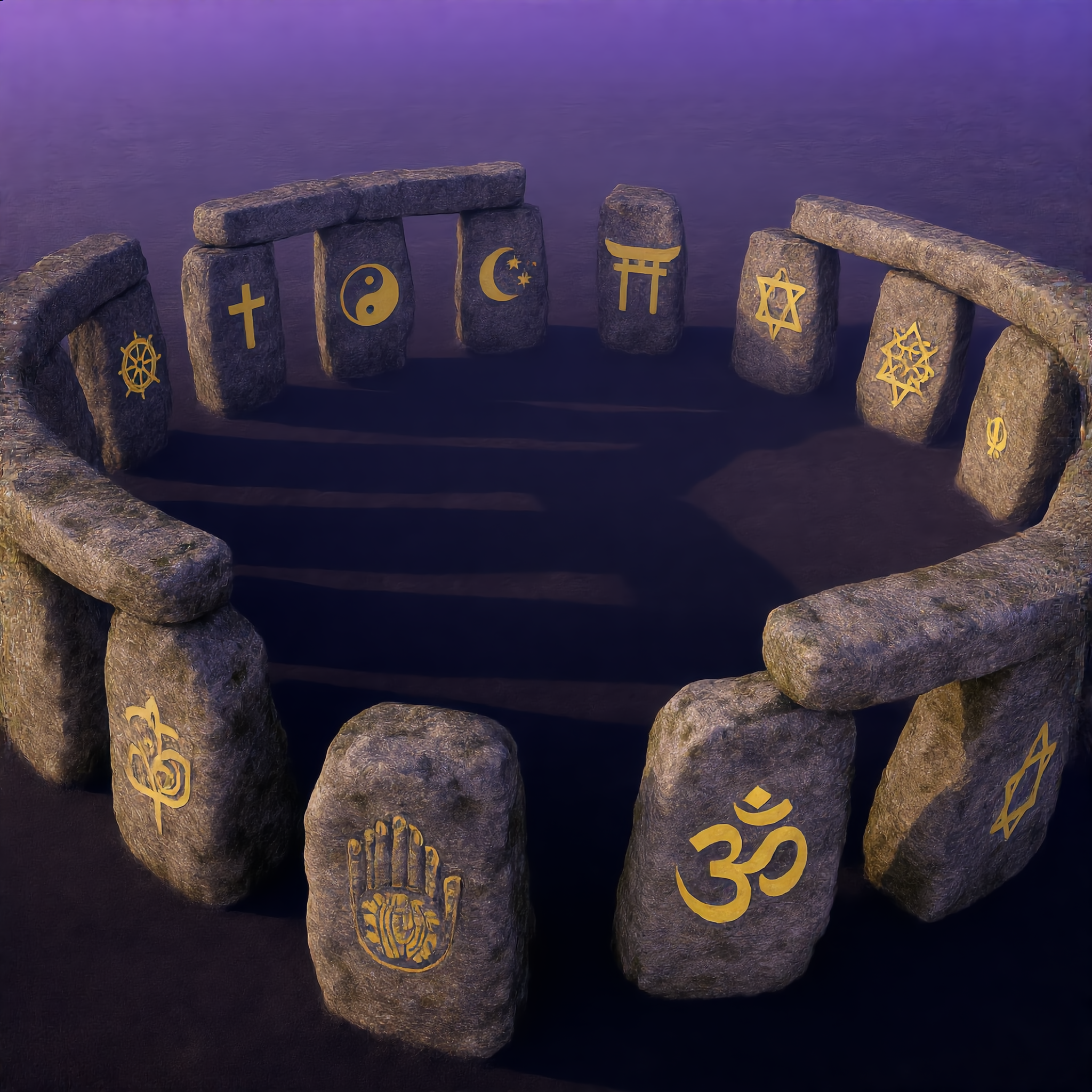
World Religions
Asatru
Buddhism
Christianity
Hinduism
The office is on the second floor of a building that has been added onto four times, and there is exactly one chair on the visitor's side of the desk, which tells you how he prefers to work.
Maps on two walls. Shelves of primary texts in languages the crew cannot read, several of them in editions with no English on the spine at all. And on the bottom shelf, in a row, forty years of field journals — spiral-bound, water-stained, numbered on the spine in marker.
He is somewhere past seventy and he has lived in more places than he lists. Not visited. Lived. Slept in the compound, ate what was served, went to the festival, sat through the ceremony, learned enough of the language to be corrected in it. He will tell you, without any apparent interest in whether you are impressed, that a religion cannot be evaluated from a distance, because from a distance every religion looks either ridiculous or interchangeable, and neither of those is what it is like from inside.
They asked him to explain a tradition and he did — clearly, in about eleven minutes, without one sentence of contempt in it. Then the Brain asked another and he did that one too.
The Scribe, who had been reading the spines, asked whether they could see a journal.
He pulled one without hesitating and opened it flat and turned it around.
It was a night entry. A village, a name for the place they had not heard of, a man dying in the next room, and the ritual being performed over him — the specifics recorded carefully and without editorial, the way a man writes when he intends to be accurate about something he does not believe. At the bottom of the page, in different ink, added later, was one line the scholar had written to himself.
They were reaching. They are always reaching.
"Forty years," he said. "Every continent, every income, tribal and urban, literate and not. I have never once found a people who had to be taught to reach. I have found plenty who were taught what to reach for, and taught it badly. But the reaching is there before anybody arrives to organize it."
The Believer had been quiet the whole time, which for him is not usual in a room like this.
"Then how do you tell the difference," he said, "between reaching and being answered?"
The scholar closed the journal and put it back in the row and did not answer him, and it was not an evasion — it was the look of a man acknowledging that the question had been asked correctly.
Nobody in that office had an answer. That is the night this transmission starts.
World Religions
"God did this so that they would seek him and perhaps reach out for him and find him, though he is not far from any one of us" — Acts 17:27
That is Paul, in Athens, standing in front of the most religiously crowded city in the ancient world, and the sentence is more careful than it looks.
Read the verb. Reach out — in the older renderings, grope, which is the word for a man's hands in a dark room. Not consult. Not study. Feel for.
Then read the word almost everyone skips. Perhaps. Paul does not say the reaching succeeds. He grants the search, he affirms the instinct, he tells a city full of altars that the impulse behind every one of them is not contemptible — and he declines to say that groping arrives. The reaching is universal. The finding is not asserted.
And then the last clause, which keeps the whole thing from being cruel: though he is not far from any one of us. The distance is not the problem. The dark is.
That is the room you are standing in. Several billion people, reaching, in incompatible directions, with the whole thing observed and recorded by a man who kept forty years of journals — and the previous room, full of philosophers climbing, could not settle it either.
The last room was men reasoning upward. This one is full of people who say something came down.
Not Tourism
This is not comparative religion as a hobby. It is field intelligence, and the field is the street a man lives on.
He is going to work beside a Muslim. His daughter is going to come home from her second semester having read something. There is going to be a Hindu family two doors down whose festival lights go up in October, and a friend from the gym who has started talking about energy and karma without any idea where either word came from, and eventually somebody at a table is going to say all religions are basically the same, aren't they — and every man present will nod, because none of them know enough to do anything else.
The man whose only contact with other religions is the bumper sticker does not know what he is being asked to coexist with. He is not tolerant. He is uninformed, and being uninformed is not a virtue with a nicer name.
And there is a second reason, closer to home. A man does not know what he believes until he knows what the alternatives are. Held next to nothing, Christianity is a set of familiar words. Held next to five serious traditions that answer the same questions differently, it becomes a set of specific claims that are either true or not — and most men have never seen theirs in that light, which is why theirs collapses so quickly the first time somebody pushes.
Two Ways This Gets Wrecked
The first is the bracket. The academic method that suspends every truth claim in order to study traditions as comparable human phenomena. It has produced enormously valuable descriptive work — most of what anybody reliably knows about the world's religions came out of it — and it refuses, on principle, the one question the man in the pew actually has. A method that can tell you everything about a religion except whether it is true has answered a different question than the one that was asked. Take the description. Decline the bracket.
The second is the flattening. The popular pluralism that says all the great traditions are saying the same thing in different cultural clothing — many paths, one mountain. It is generous, it is well-meant, and it does not survive ten minutes of contact with the actual texts.
The Christian doctrine of God as Trinity is not the Hindu doctrine of Brahman with a cultural accent. Bodily resurrection is not nirvana with a translation problem. Grace through Christ is not submission to Allah with different vocabulary — Islam explicitly and deliberately denies the crucifixion, which is the single event Christianity is built on, and no amount of goodwill dissolves a contradiction that direct.
⚠ And here is the part the flatteners never notice: their position is the least respectful one in the room. To tell a devout Muslim, a devout Buddhist and a devout Christian that they are all really saying the same thing is to tell all three that none of them understood their own tradition, and that a Western reader with a paperback anthology understood it better. Actual respect means taking a man's claim seriously enough to say it might be wrong.
The traditions diverge on the questions everything else hangs on. The divergences are real. Say so, and then do the work of finding out what they actually are.
The Traditions, Straight
Christianity — the home tradition, and the one held to the same standard as the rest of this list. Built at depth in Christianity: Intro to Christianity, Christian History and Important Events, the Christian Denominations room with its full range from Catholicism and Eastern Orthodox through Lutheran, Reformed, Baptist, Methodist, Anglican, Presbyterian, Quaker, Anabaptist Mennonite, Pentecostal Charismatic, Non-Denominational Evangelical, Restoration Movement, Seventh-day Adventist and Oriental Orthodox — plus Customs & Traditions, Holidays & Ceremonies and Rituals & Rites.
Judaism — the tradition the Hebrew Scriptures came out of, and the root the Christian branch was grafted into. The Second Temple's destruction and the rabbinic development that followed it, the Talmudic centuries, the medieval commentators, the mystical stream, the Hasidic revival, and the Orthodox, Conservative, Reform and secular Jewish world a man actually meets today. ⚠ The New Testament handles the relationship itself at length; read it there before reading it through any modern political lens.
Islam — roughly two billion people. The seventh-century revelation, the recorded life of Muhammad, the Sunni and Shia division that began as a succession dispute and became a civilization-level split, and the schools of law that govern practice. Tawhid — the absolute, undivided oneness of God — is the load underneath everything, and it is the reason the Trinity is not a misunderstanding to be cleared up but the specific thing Islam was formulated to deny.
Hinduism — not one religion but the layered religious life of a subcontinent across four millennia, with no founder, no central authority and no single scripture. Built at depth in Hinduism, with the Hindi Gods material and Kali as a worked example. Advaita monism, the devotional bhakti traditions and village practice are three different worlds under one word.
Buddhism — around half a billion people, and the tradition most misrepresented in the West, where it arrives as a breathing technique with its metaphysics surgically removed. Built at depth in Buddhism — the four claims, the doctrine of non-self that everything hangs on, and the three vehicles.
Taoism — the Chinese tradition descended from the Tao Te Ching: the Tao as the underlying order, wu wei as non-forcing, the complementarity of opposites. Temperamentally unlike everything around it, and the quiet source of a great deal of contemporary wellness vocabulary.
Sikhism — founded by Guru Nanak in the Punjab five centuries ago, drawing from Hindu and Islamic sources while explicitly refusing both. Monotheist. Rejects caste in principle. The scripture itself is treated as the final living Guru.
Shinto — the indigenous Japanese tradition of kami, shrine and rite, historically braided with Buddhism into something neither is alone.
Atheism — included on this list deliberately, and built at depth in Atheism. The bare claim is not a religion. The lived system is doing every job a religion does — an account of reality, of the person, of morality, of death, held with conviction, absorbed rather than derived — and treating it as the neutral ground from which the others get judged is the single most common error in this whole subject.
Modern revivals and reconstructions — the Norse revival in Asatru is the case worked here, because it is aimed squarely at the men this program was built for, and because its sourcing problem is a lesson in itself.
Indigenous and tribal traditions — animist, ancestral, shamanic, across every inhabited region. Folklore & Mythology handles the narrative side; Shamanism handles the practice.
⚠ Say plainly what is not built yet. Islam, Judaism, Taoism, Sikhism and Shinto are named here and have no rooms of their own. Islam and Judaism in particular are indefensible gaps — one is the second-largest religion on earth and the other is the tradition Christianity came out of. They are the next thing this section owes.
Six Axes, and You Run Them on Every One
Comparison without a method is just impressions. Six questions, asked of every tradition including your own, in the same order, with the same seriousness.
What is God? One, many, none, or everything. Monotheism, polytheism, non-theism, pantheism — four different architectures, and everything else in a system is shaped by which one it starts from.
What is a person? An image-bearer, a soul in transit, a process with no fixed center, a slave, a spark of the divine, an organism. ⚠ This is the axis that predicts the most: tell me what a tradition says a person is and I can tell you what its civilization will do to people it has power over.
Why is anything wrong? A fall, ignorance, craving, imbalance, karma, illusion, or nothing in particular. Every tradition has a diagnosis. They are not variations on one another.
What is the way out? Grace, works, knowledge, devotion, discipline, submission, ritual, or the recognition that there was never anyone trapped. This is the axis where the differences stop being academic.
Where does it end? Resurrection into a renewed material world. Escape from matter altogether. Absorption. Cessation. Paradise. Ancestral continuity. Nothing.
And what has it actually produced? The same track-record discipline Schools of Thought runs, applied here, to everyone, with no exemptions. What kind of man does a lifetime inside this tradition make, and what have the civilizations built on it done when they had power? ⚠ Christianity gets the same audit — the hospitals, the universities, the abolition movements and the inquisitions, the complicity, the long alliances with power that nobody reading the Gospels straight would have predicted. A room that runs the ledger on everyone else and exempts the home tradition has forfeited the right to run it at all.
What Everybody Got Right
Before the divergences, the agreements, because a man who cannot name what another tradition sees correctly is not equipped to say where it goes wrong.
"Yet he has not left himself without testimony: He has shown kindness by giving you rain from heaven and crops in their seasons; he provides you with plenty of food and fills your hearts with joy" — Acts 14:17
Paul says that to a pagan crowd in Lystra that has just tried to sacrifice oxen to him. He does not tell them their religious instinct is worthless. He tells them it has been responding to something real — that the rain and the harvest and the ordinary human experience of gladness were a testimony, given deliberately, to people who had never had a prophet or a scripture.
That is the scholar's forty years, stated in one verse. The reaching is not a mistake. It is a response.
So: the dharmic traditions are correct that grasping produces misery, and most Western Christians live as though they had never heard it. Islam is correct that God is one, that he is not a member of the universe, and that a great deal of Western religion has become sentimental about him. Judaism is correct that the covenant is with a people and not merely with individuals, and that obedience is not a lower thing than sincerity. The indigenous traditions are correct that the world is not inert, that the dead deserve honor, and that a place can matter. The reconstructionists are correct that a man needs lineage and a code. Even the atheist is correct that a faith which has never been examined is not worth much.
None of that is a concession. Every one of those is a place where somebody is holding a real piece of the truth — and none of it settles the question, which is what the next section is for.
Where They Actually Divide
Now the divergences, stated as they stand rather than softened.
"For even if there are so-called gods, whether in heaven or on earth (as indeed there are many 'gods' and many 'lords'), yet for us there is but one God, the Father, from whom all things came and for whom we live; and there is but one Lord, Jesus Christ, through whom all things came and through whom we live"
— 1 Corinthians 8:5-6
⚠ Notice the structure, because Paul does something here that modern people almost never do. He concedes the plurality and then names one. He does not pretend the other claimants are not being made, does not wave at the crowded field, does not act as though his position is obvious. There are many. For us, one — and then he says which, and by name.
That is the posture. Full acknowledgment of the field, no flattening, and a claim made in the open where it can be examined.
Four things Christianity says that no other major tradition says:
God is three and one. Not three gods, not one God in costumes. A unity that is a relationship — which means love was going on before there was anything to love, and is therefore what God is rather than something he does to us.
God became one of us. Not appeared as. Not sent a messenger about. Entered — as an infant, in an occupied province, with a birth certificate's worth of specifics. Every other tradition has God speaking, sending, revealing or manifesting. One says he arrived in a body and stayed in it.
God died, and did not stay dead. A specific execution, under a named governor, on a datable afternoon, followed by a claim that the same body ate breakfast on a beach. Every other tradition can survive its founder being historically wrong about the details. This one cannot, and it has never pretended otherwise.
And the way out is a gift. Every other system, at bottom, gives a man something to do — a path, a law, a discipline, a knowledge, a submission — and every one of them works exactly as well as he does. One says the account was settled by somebody else and is handed over, and that this is the only reason anybody arrives at all. That is either the best news ever delivered or the largest lie ever told, and it is not the sort of claim that can be partly true.
"You Samaritans worship what you do not know; we worship what we do know, for salvation is from the Jews" — John 4:22
⚠ That is Christ, doing comparative religion, at a well, with a woman from a tradition his own people despised — and read what he does with it. He is warm with her. He asks her for water. He is going to tell her more about himself in this conversation than he has told most people. And he does not flatten a thing: you worship what you do not know. He names the divergence to her face, in a friendly conversation, without contempt and without softening, and the friendship survives it.
If that combination is possible, then nobody gets to claim that honesty about differences requires being unkind, or that kindness requires being vague. He did both in one sentence.
Closing the Transmission
Go back to the line in the journal, because the Believer's question deserves the honest answer and the honest answer is what ends this section.
They were reaching. They are always reaching.
Forty years of fieldwork produced that sentence, and it is worth everything it cost. It is also, on its own, not an answer. It establishes that the search is universal and human and not contemptible. It cannot tell you whether anyone has ever been found.
And here is the thing about this room that has to be said plainly before anybody leaves it: comparison has never converted anybody. Not once. A man can hold six traditions in his head accurately, name every axis, run every ledger, describe each one better than most of its own adherents — and be exactly as far from the truth as he was before he started, because knowing what the options are is not the same as knowing which one is the case, and no amount of the first ever turns into the second.
The scholar knew that. It is why he did not answer.
So you have a map now. Understand precisely what a map is worth. It will keep you from saying stupid things about your neighbor's faith. It will keep you from being flattened by the man at the dinner party who has read one book. It will let you sit with a Muslim colleague or a Buddhist brother-in-law and be a person rather than a project.
And it will not survive a sixteen-year-old at a kitchen table asking how you actually know any of it is true.
That is the next room, and there is no way around it. Not for the man who believes this and has never once been made to say why — he is about to find out that sincerity is real and not transferable. And not for the man who has read this whole section and does not believe it, either; he is owed the actual arguments rather than a shrug, and that room is where they are kept.
⚠ Nobody goes out to the field from here. The road runs through the room where a man learns to give an answer — and only then out to what he is for.
"My name will be great among the nations, from where the sun rises to where it sets" — Malachi 1:11
Delivered to a discouraged remnant in a half-repaired temple, about the same nations this file has spent its length describing. Not the nations will be corrected. Not the nations will be defeated. From sunrise to sunset, in every place — which means the reaching in the scholar's journal is not a problem to be solved. It is the beginning of an answer somebody else is already giving.